

Do you want to become a UI/UX designer? We’ll show you how to go from beginner to professional in this 7-step guide.
UX/UI designers create digital products that are both aesthetically pleasing and enjoyable to use. The role requires a broad and diverse set of skills—but learning those skills is just the first step towards becoming a professional UI/UX designer.
So what else does it take? From building your portfolio to growing your network and navigating the UX/UI job market—we set out the seven key steps you need to follow.
Contents:
- 1) Learn UX/UI theory and fundamentals
- 2) Get a UX/UI qualification
- 3) Create your portfolio
- 4) Get practical experience
- 5) Network
- 6) Understand the UX/UI job market
- 7) Know how to sell yourself
- 8) What next?
Here’s how to become a UI/UX designer.
1. Learn UX/UI design theory and fundamentals
Before becoming a UI/UX designer, it’s essential to understand exactly what a UI/UX designer does. Start your journey by learning about the fundamental concepts, rules, and principles that underpin UX/UI design.
We’ve put together a complete step-by-step guide to learning UX/UI here, but here are some tips to help you get started:
- Read up on what UX/UI design is, and get an overview of all the different steps in the UX/UI design process
- Learn about usability principles and the psychology of human behaviour
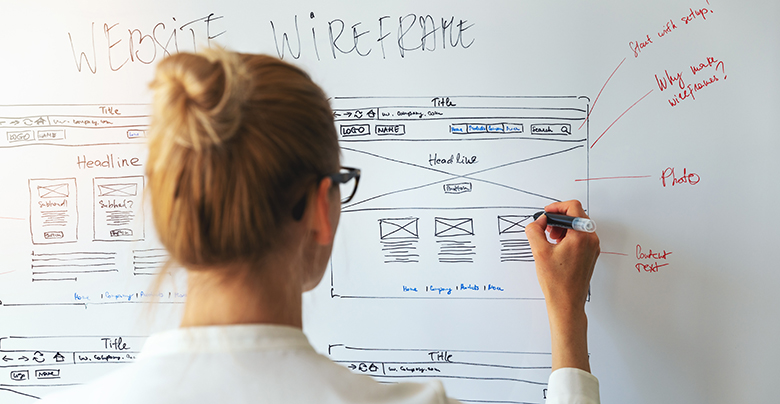
- Understand the various deliverables that UX and UI designers create—such as user personas, user flows, wireframes, and prototypes
- Learn about the various tools UX and UI designers use (such as Figma, Sketch, and Adobe XD)
Think of this as your discovery phase. You’re familiarising yourself with all things UX/UI, getting a good foundation of knowledge in place before you start actively acquiring those key UX/UI skills.
2. Get a UX/UI design qualification
Next, you’ll want to move beyond information-gathering and free tutorials towards a formal UX/UI design qualification.
This has several benefits. Firstly, it brings structure and logic to your learning. You don’t know what you don’t know, so it’s useful to have a curriculum you can follow. Secondly, it may help you with other aspects of becoming a UX/UI designer besides learning UX/UI skills—such as networking and building your portfolio.
Lastly, it provides employers with tangible proof that you’re a qualified UX/UI designer. Of course, they’ll mostly be referring to your portfolio to see what you’re capable of, but a legitimate qualification further boosts your credentials.
If you’re not sure what kind of qualification to go for, this guide will help you: The Best UX/UI Design Courses To Do in 2023.

3. Create your UX/UI portfolio
You’ve put considerable time and effort into learning UX/UI skills and getting a qualification. To cross the bridge from learning to doing, you’ll need a professional design portfolio.
Your portfolio (usually a website) hosts a selection of UX/UI projects you’ve worked on. It shows employers that you’re able to go beyond theory and actually apply your skills to real projects. Ultimately, that you’re capable of doing the job.
It also conveys your personal brand, giving insight into what kind of designer you are (or aspire to be), where your interests and values lie, and what types of projects and causes you’re passionate about.
Your portfolio is one of the very first things an employer will look at, so it’s important to get it right. We show you how to create a UX/UI portfolio in this guide.
4. Get practical experience
This is perhaps the trickiest part about becoming a UI/UX designer. As it’s such a practical field by nature, it can be difficult to land a paid role if you don’t have any experience. It’s not impossible, but you’ll certainly boost your chances of getting hired if you can practise your skills in the real world first.
One possible option is to practise at your current place of work. Is there any scope in your job to apply your UX/UI skills? Does something need redesigning, or could your department benefit from some user research sessions which you could lead? It won’t be possible in every role, but try to find opportunities to bring UX/UI into what you’re already doing.
If you’ve got the time to spare, consider volunteering your skills. UX India (India’s biggest UX conference) has volunteer opportunities in a variety of areas, as does India Welfare Trust (including UX/UI projects specifically). Google is your best port of call here: simply search for UX/UI volunteering opportunities and see what’s available both locally and remotely.
Another popular route among new UX/UI designers is to complete a hypothetical project. For example, in his hypothetical Indicarz project, UX designer Rohit Raj set himself the task of designing a car rental app. He identified his target audience and user problem, then set about designing the solution. While it’s not a real-world project, it demonstrates his ability to apply critical UX/UI skills to real-world challenges.
5. Network
Networking is extremely valuable when it comes to breaking into and navigating a new industry. So, if you want to become a UI/UX designer, make a concerted effort to build and grow your network.
There are many different ways to network. You can make connections and spark conversations on LinkedIn, attend industry meetups, ask that designer friend of a friend for coffee, reach out to other students on your UX/UI design course, or get chatting to fellow attendees at conferences and webinars.
Wherever you choose to network, it’s important to follow some golden rules around networking etiquette—like practising active listening, asking others about themselves, and following up.

6. Understand the UX/UI job market
As you’re reading this post, you presumably want to procure a UX/UI design job. An important—yet often overlooked—step towards that goal is taking the time to understand the UX/UI job market.
UX/UI designer is just one job title. Beneath this broad umbrella, there are dozens of other job titles and specialist roles: UX researcher, UX writer, information architect, UI developer, product designer…the list goes on!
Research different job titles within the field, and browse job sites (like Indeed and LinkedIn) to get a feel for how employers interpret each role. What skills are typically required for different positions? What tasks and responsibilities are associated with each job title? How do employers tend to differentiate between junior and senior design roles?
This will help you to understand what employers are looking for—and to determine the direction you’d like your own career to take.
7. Know how to sell yourself
You’ve mastered the essential skills. You’ve got a professional qualification to your name, you’ve built an impressive portfolio, and you’re in the process of growing your industry network.
You’re well on your way to becoming a UI/UX designer. Now there’s just one thing left to do: apply for jobs. But, before you go ahead and click ‘Apply’ on all those exciting vacancies you’ve found, make sure you’re selling yourself properly.
What does that mean exactly? Ultimately, it’s about positioning yourself as a qualified designer. In addition to your portfolio, your resume and LinkedIn profile should also tell the story of you as a UI/UX designer—highlighting your relevant skills and experience front-and-centre.
This is especially important if you’re crossing over from an unrelated field, as your design-related credentials might not be so obvious to a recruiter. Make sure that anyone glancing at your resume or LinkedIn profile for the first time can quickly deduce that you’re an aspiring designer with the necessary skills—don’t make them work to figure out why you’re suitable for the role.
Follow those seven steps and you’ll soon be accepting your first UX/UI design job offer. Good luck!
8. What next?
Are you keen to take the first step towards becoming a UI/UX designer? If yes, then here are some steps you can take:
1. Watch this session by Shiva Viswanathan, Design Head of Ogilvy Pennywise, and Naman Singh, Product Experience Designer at RED.
2. Talk to a course advisor to discuss how you can transform your career with one of our courses.
3. Pursue our UX UI Design course, which is taught through live, interactive classes by industry experts, and comes with a Job Guarantee.
4. Take advantage of our scholarship and funding options to overcome any financial hurdle on the path of your career transformation.